Reducing cognitive load for clinicians under pressure
Clinicians make hundreds of decisions per shift. We design interfaces that surface critical information instantly, reducing the mental effort required to deliver safe, effective care.
Disrupting healthcare
Designing trusted digital health experiences for clinicians and patients.
Change how clinicians deliver care and how patients experience it, from EHR workflows and clinical decision support to patient portals and remote monitoring, with design that reduces friction where it matters most. Healthcare UX carries a weight no other industry does: a poorly designed interface can cost time, cause errors or erode trust at the worst possible moment. We design knowing the stakes.
What we solve
Clinicians make hundreds of decisions per shift. We design interfaces that surface critical information instantly, reducing the mental effort required to deliver safe, effective care.
Regulatory requirements in healthcare are non-negotiable. We embed compliance into the design process, consent flows, audit trails and privacy-first architecture, not as an afterthought.
The same platform must work for a specialist who uses it eight hours a day and a patient who uses it once a year. We design for both without compromising either.
Healthcare organisations run on deeply embedded systems. We design transitions that improve the experience without forcing clinicians to relearn workflows they depend on every day.
Where we work
How we help
Shadowing clinicians, interviewing patients and mapping care journeys to find where design can reduce harm and friction.
Clinical dashboards, patient portals and telehealth flows designed for high-stakes, time-pressured use and tested in conditions that resemble a real shift.
Accessible, bilingual design systems that keep complex healthcare product ecosystems consistent without slowing down the teams that build them.
Clinical, operational and patient insight translated into product decisions that improve outcomes, not just satisfaction scores.
Healthcare across the region is being rebuilt around the patient’s phone. Saudi Arabia’s Vision 2030 health transformation programme is shifting care from hospital to home, with national apps for appointments, prescriptions and records; the UAE has been unifying health records emirate by emirate and licensing telehealth at scale; and in Lebanon, private hospital groups and health-tech start-ups are building digital front doors for a system under enormous strain.
For clinicians this means more screens, not fewer. The same doctor moves between an EHR, a decision-support tool, a telehealth console and a messaging app in a single consultation, and every extra click is time taken from the patient in front of them.
For patients it means that trust in a hospital is now formed before they arrive: in the booking flow, in the way results are explained, and in whether the app speaks their language, Arabic, English or both, plainly enough to be understood by someone who is frightened.
We start on the ward, not in Figma. Shadowing clinicians through a shift, sitting with patients in the waiting room and mapping the care journey end to end tells us where time is lost, where errors are likely and which steps carry the most risk. Those become the journeys we design first.
Clinical interfaces are then designed for speed and error prevention, clear hierarchy, confirmation on irreversible actions, alerts that mean something, and patient-facing products for reassurance and low cognitive load. Both are tested with representative users in realistic conditions, and both run on a shared, accessible, bilingual design system that your engineers and vendors can extend without us. Privacy and consent patterns are agreed with your compliance team early, so they shape the design rather than interrupt it.
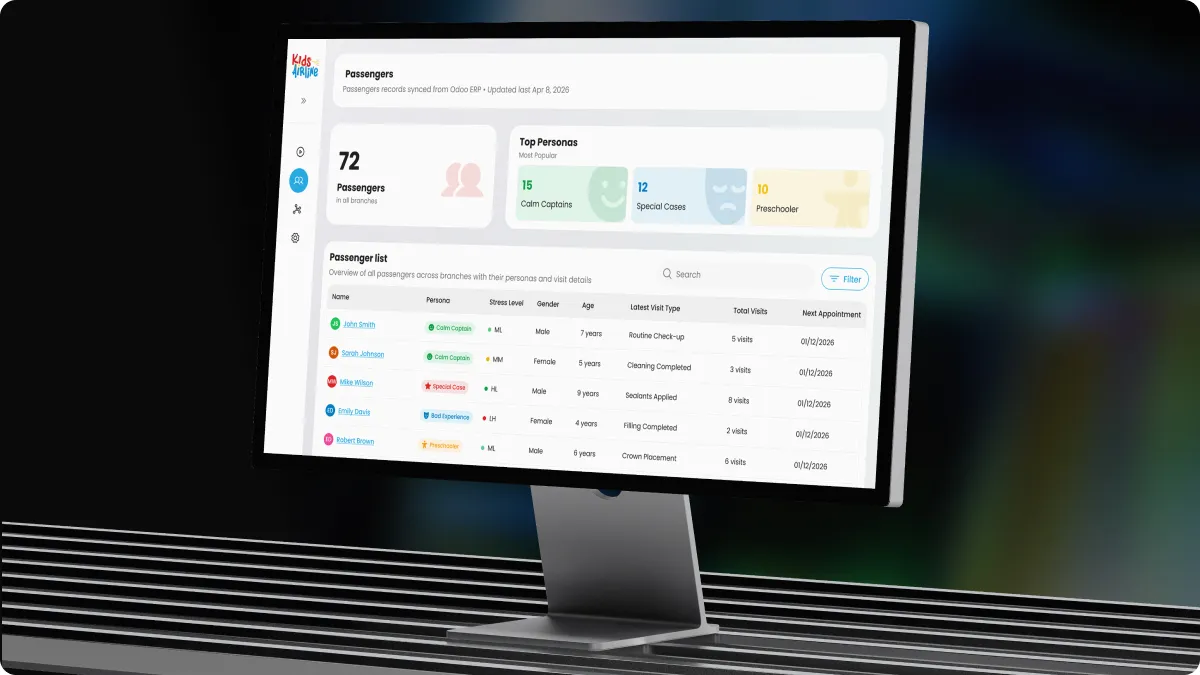
See Kids Airline for how we design for anxious users and the people caring for them, the same research-led discipline we bring to patient-facing healthcare products.
Related work
A clinical web dashboard for a paediatric dental clinic that reframes treatment as a flight, streaming live biometrics to the clinician while giving anxious children a familiar, reassuring journey from check-in to exit.
Services for healthcare & health tech
FAQ
Yes. We design with regulatory constraints as a core requirement, not a late-stage filter. That means structuring data flows, consent patterns and information architecture around what's permissible under HIPAA and GDPR from the first wireframe. We work closely with your legal and compliance teams to ensure design decisions are documented and defensible, and we know which UX patterns create risk, so we can steer around them early.
In healthcare, poor UX has real consequences, so success metrics are held to a higher standard. We measure task completion accuracy, time-on-task for critical workflows, error rates before and after redesign, and clinician or patient satisfaction scores. For patient-facing products, adoption and adherence rates are strong indicators. For clinical tools, reduction in workflow friction and support ticket volume tell us whether the design is genuinely working.
Yes, and we treat them as fundamentally different design problems. Clinical interfaces prioritise speed, information density and error prevention for trained users working under pressure. Patient-facing products prioritise clarity, reassurance and low cognitive load for users who may be anxious, unwell or unfamiliar with medical terminology. We adjust our research methods, personas and validation approaches accordingly for each context.
We lead with research, understanding the clinical environment, the workflows and the real users before touching any interface. Healthcare UX requires deep contextual knowledge: the constraints clinicians operate under, the emotional state of patients, and the systemic factors that shape behaviour. We map existing workflows before redesigning them, involve clinical stakeholders throughout, and validate with representative users in conditions that reflect actual use, not idealised lab settings.
Error reduction is a design outcome, not a feature. We apply established safety principles, clear information hierarchy, confirmation steps for irreversible actions, consistent interaction patterns, and prominent alerts that don't cry wolf. We design around common failure modes: confirmation bias, alert fatigue and time pressure. Usability testing with clinical staff in realistic task scenarios helps us surface where the interface might cause hesitation, misreading or incorrect action, before it goes live.
Yes. We design for hospital groups, insurers, telehealth providers and health-tech companies working within the health authorities and data-protection rules of Saudi Arabia, the UAE and Lebanon, regimes that treat patient data as among the most sensitive categories of personal information, often with requirements that it stays in-country. Our role is the experience layer: your clinical, legal and compliance teams define what is required, and we design how it feels to the clinician and the patient.
Arabic and right-to-left layout is a foundation of how we work, not a translation step at the end. Medication names, dosages, lab values and appointment times mix Arabic text with Latin script and numerals, so bidirectional typography, mirrored clinical layouts and bilingual patient communications are designed and tested in Arabic from the first wireframe, then adapted to English, with the patient-facing language kept plain in both.
More industries
Reach us
Tell us where your product stands today. We’ll come back within two working days with how we’d approach it.