Balancing regulatory compliance with frictionless onboarding
KYC, AML and open-banking consent requirements create mandatory friction. We design flows that satisfy regulators without losing users mid-journey.
Disrupting finance
Transforming legacy financial complexity into experiences users trust.

Change how your users experience financial products, from onboarding and KYC flows to wealth dashboards and claims management, with design grounded in regulation, research and radical clarity. Retail banking, WealthTech, payment infrastructure and insurance platforms all share one truth: users abandon when friction exceeds trust. We design the other way around.
What we solve
KYC, AML and open-banking consent requirements create mandatory friction. We design flows that satisfy regulators without losing users mid-journey.
Rebuilding front-end experiences on top of ageing core systems demands UX that hides complexity rather than inheriting it. We bridge legacy and modern without breaking trust.
Financial data has to be readable at a glance for both power users and first-timers. We turn dense datasets into decision-enabling interfaces.
In financial products, trust is built or broken in milliseconds. Every empty state, error message and loading screen is a moment to reassure, or lose, your user.
Where we work
How we help
Where the product should go, which journeys matter most, and how success will be measured before design starts.
Regulatory steps mapped early, so disclosures, consent and verification become part of the journey rather than a wall in front of it.
Accessible, bilingual component libraries that keep hundreds of banking screens consistent across web, iOS and Android.
End-to-end flows, edge cases included, prototyped and tested with real customers before engineering begins.
The region’s financial products are being rebuilt at pace. Saudi Arabia’s Vision 2030 and its Financial Sector Development Program have pushed digital banking, open banking and a cashless economy to the top of every bank’s roadmap; the UAE has licensed digital-only banks and payment platforms at a rate few markets can match; and in Lebanon, mobile banking has become the primary branch for a generation of customers who rarely visit one.
What this means for design is simple: the interface is the bank. Customers judge trust, speed and competence by the onboarding flow, the transfer screen and the way an error is explained, in Arabic and English, on a four-year-old Android phone, over a patchy connection.
We start with the journeys that carry the most risk and the most value: opening an account, verifying identity, making a first payment, recovering access. Each is mapped against the regulatory steps it must contain, then prototyped and tested with real customers until the flow is both compliant and effortless.
From there we build the system that keeps hundreds of screens coherent, a bilingual, accessible component library with clear rules for numbers, dates, currency and bidirectional text, and hand it to your engineers with the documentation they need to extend it without us.
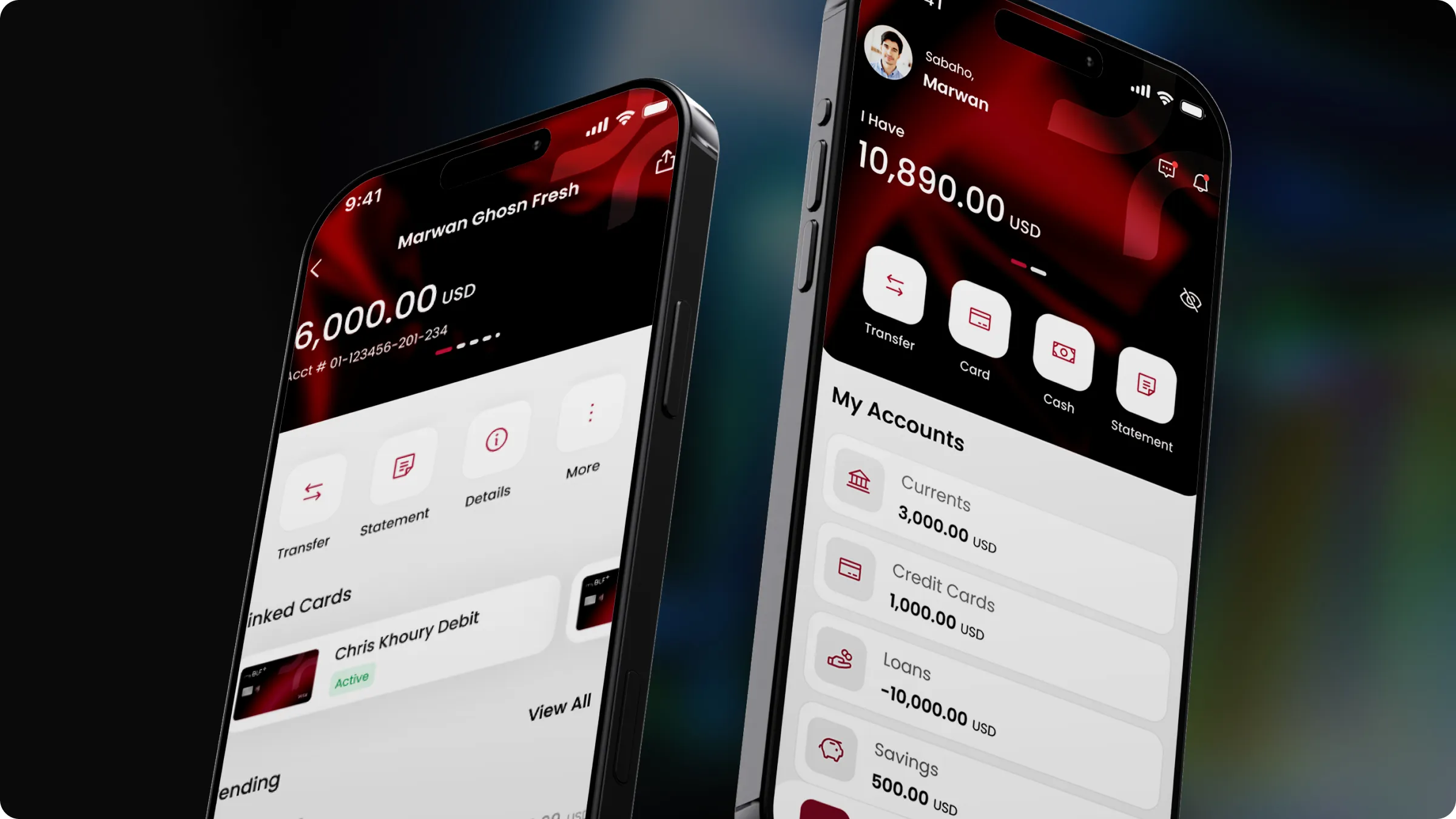
For BLF Bank we designed MyBLF, a mobile banking app for Lebanon built around a smarter way to bank: a clear account overview, transfers that take seconds and an onboarding flow designed for customers switching from branch to phone.
Related work
A redesign of BLF Bank’s mobile banking app for customers in Lebanon, rebuilding trust through clear confirmation moments, navigation shaped around how people actually bank, and onboarding that removes hesitation from the very first screen.
Services for banking & fintech
FAQ
Fintech UX projects typically take anywhere from a few weeks to several months, it all depends on what you need. A quick audit or a single feature redesign can wrap up in 2–4 weeks, while a full product design from scratch usually takes 3–6 months. Financial products also tend to involve extra rounds of review for compliance and security, which adds time. We always scope the timeline clearly upfront so there are no surprises.
Yes, and it's one of the areas where having the right design partner makes the biggest difference. We've worked on financial products where compliance wasn't an afterthought but a core design constraint from day one: KYC flows, transaction disclosures, consent screens and audit-ready interfaces. We know how to design experiences that satisfy regulatory requirements without making users feel like they're filling out paperwork. The result is products that pass legal review and still feel intuitive to use.
Absolutely. We're built to integrate, not replace. Whether you have an established design system we need to work within, an engineering team with specific handoff requirements, or both, we adapt to your workflow. We're fluent in Figma, familiar with most component libraries, and experienced in delivering production-ready specs that developers can actually build from. If your design system needs extending or cleaning up along the way, we can help with that too, without disrupting what's already working.
A great fintech onboarding experience does one thing above all else: it builds trust fast. Users are being asked to hand over sensitive personal and financial information, often within the first few minutes. The best onboarding flows are short and progressive, they only ask for what's needed at each step, they're transparent about why identity information is required, and they give users a clear sense of progress. On the compliance side, the challenge is making legally required steps, disclosures, consent screens, ID checks, feel like a natural part of the journey rather than a bureaucratic wall. Great fintech onboarding feels effortless to the user and airtight to the compliance team. Getting both right at the same time is exactly what we do.
Yes. We design for banks and fintechs operating under SAMA and CBUAE frameworks, including open-banking consent journeys, national-ID-based onboarding and Arabic-first interfaces. Our role is the experience layer: we work with your compliance team on what is required and design how it feels to the customer.
Arabic and right-to-left layout is a foundation of how we work, not a translation step at the end. Numerals, date formats, mirrored navigation, bilingual typography and bidirectional text in transaction lists are designed and tested in Arabic from the first wireframe, then adapted to English.
More industries
Reach us
Tell us where your product stands today. We’ll come back within two working days with how we’d approach it.