Designing for every citizen, regardless of digital literacy
Government services must work for everyone. We design with plain language, progressive disclosure and inclusive research that goes beyond the digitally native majority.
Disrupting public services
Connecting citizens to trusted, accessible public services at scale.

Change how citizens interact with government, from permit applications and benefit claims to smart city dashboards and emergency response, with design grounded in inclusion, research and radical simplicity. Government platforms serve everyone: the digitally native and the digitally excluded, the urban and the rural, the able-bodied and those with disabilities. We design for all of them.
What we solve
Government services must work for everyone. We design with plain language, progressive disclosure and inclusive research that goes beyond the digitally native majority.
Decades-old systems, paper-based processes and siloed databases can't be ignored, they must be bridged. We design citizen-facing experiences that work on top of existing back-end constraints.
Trust is the foundation of every government service. Every form field, error message and confirmation screen is a moment to either reinforce or erode public confidence.
Citizens access government services on phones, kiosks, desktops and in person. We design systems that are consistent across every touchpoint without requiring separate builds.
Where we work
How we help
Inclusive discovery with real citizens, interviews, accessibility audits and usability testing across the full range of people a public service has to serve.
Portals, internal tools and smart public platforms designed so a first-time user finishes the task without calling for help.
Unified design systems that scale across departments and meet digital service standards, so every ministry ships the same quality.
Stakeholders aligned around evidence, so digital transformation decisions are made on what citizens need rather than on departmental habit.
Public services across the region are moving online at a pace few governments have attempted. Saudi Arabia’s Vision 2030 has made digital government a national priority, with the Digital Government Authority setting the standards every ministry and authority is expected to meet; the UAE has spent a decade building smart-government services and a single national digital identity across federal and emirate-level entities; and Lebanon’s public institutions are digitising services that, until recently, lived entirely on paper and in queues.
The citizen does not see the programme. They see a form on a phone, a status page that may or may not explain what happens next, and an error message when a document fails to upload. Whether a service feels like progress or like the same queue moved online is decided in those screens.
That places unusual demands on design. A government platform has to work for a graduate in Riyadh and a grandparent in a village with one bar of signal, in Arabic and English, on a kiosk, a desktop and a four-year-old Android phone, and it has to be accessible by default, because for many citizens there is no other channel.
We begin with the services that generate the most demand and the most calls to the helpdesk: a permit application, a benefit claim, a renewal, a complaint. Each journey is mapped end to end, including the paper steps and back-office hand-offs the citizen never sees, then prototyped and tested with a deliberately diverse group of citizens, not a convenient sample of digital natives.
From there we build the system that keeps a whole ministry consistent: a bilingual, accessible component library with clear rules for forms, status tracking, notifications and document handling, documented so in-house teams and vendors can extend it without us. Procurement frameworks, security reviews and sign-off gates are planned into the schedule from the start rather than discovered halfway through.
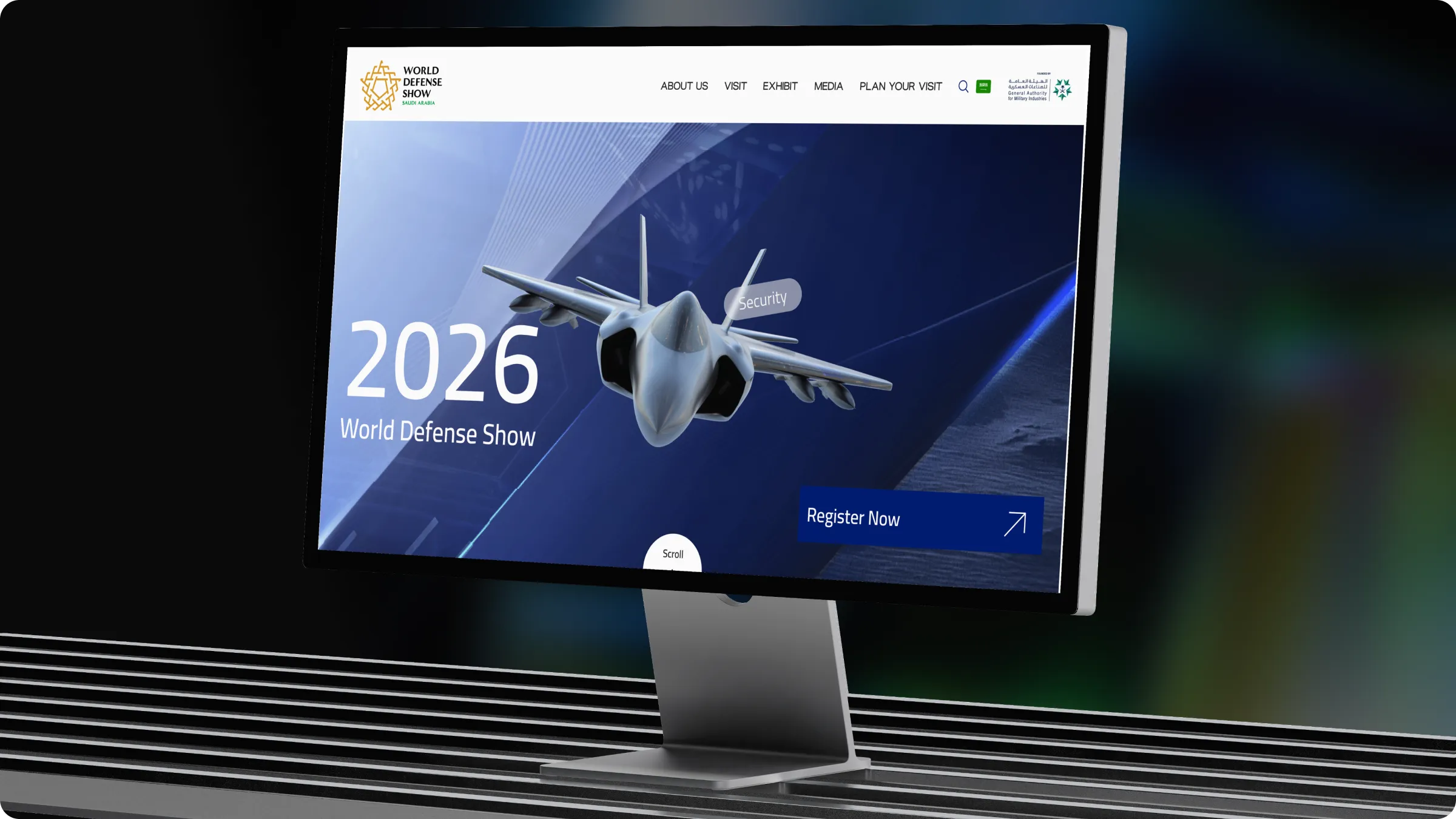
For the World Defense Show, a government-backed defence and security exhibition in Saudi Arabia, we designed the digital experience that connects exhibitors, delegations and visitors before and during the event.
Related work
A persona-driven website for the World Defense Show in Saudi Arabia, one platform serving visitors, exhibitors and sponsors before, during and after the exhibition, built on a design system calibrated for institutional authority.
Services for government
FAQ
Yes. We're experienced working within structured procurement frameworks and understand the constraints that come with public sector engagements, from phased approval cycles to documentation requirements and data handling protocols. We adapt our process to fit your compliance environment without compromising design quality or timelines.
Success in the public sector is measured by service adoption, task completion rates and reduction in support burden, not vanity metrics. We track how efficiently citizens complete key service journeys, how much drop-off decreases, and whether call centre or in-person visits reduce as a result of better digital self-service. We align KPIs with your ministry or department's mandate from the start.
Government projects vary widely by scope and approval structure. A focused service redesign or digital form optimisation typically runs 6 to 10 weeks. Larger platform projects, citizen portals, multi-service hubs or full design system build-outs, can run 4 to 9 months. We build in review gates that align with your internal sign-off process so nothing stalls unexpectedly.
Yes, and we treat accessibility as a design requirement, not an afterthought. We design to WCAG 2.1 AA standards as a baseline, and apply inclusive design principles throughout, considering users with visual, motor, cognitive and hearing differences from the earliest wireframe stage. Accessibility testing is part of our standard QA process, not a final checkbox.
We start with plain language, clear labels, minimal jargon and straightforward instructions at every step. Interaction patterns are kept familiar and forgiving, with inline guidance, progress indicators and graceful error recovery. For low-literacy or first-time digital users, we validate designs through usability testing with diverse citizen profiles, not just tech-savvy proxies. The goal is a service that works for everyone, not just the average user.
Yes. We design citizen-facing services for ministries, authorities and government-owned entities working within the region's digital government programmes, the Digital Government Authority's standards in Saudi Arabia, federal and emirate-level digital government guidelines in the UAE, and the digitisation of public services under way in Lebanon. Our role is the experience layer: your teams own policy and compliance decisions, and we design how the service feels to the citizen, Arabic first, with national digital identity sign-in, bilingual forms and accessibility built in from the start.
Arabic and right-to-left layout is where we start, not a translation pass at the end. Form labels, Hijri and Gregorian dates, numerals, mirrored navigation, bilingual notifications and document uploads are designed and tested in Arabic from the first wireframe, then adapted to English. We also test with citizens who are not fluent readers in either language, because public services have to work for them too.
More industries
Reach us
Tell us where your product stands today. We’ll come back within two working days with how we’d approach it.